When I first started this website and began yelling into the void that is the internet, I had one dream.
Not a book deal.
Not a viral post.
Not thousands of followers hanging on every badly punctuated sentence.
Just one person.
If something I wrote found its way into the right hands, at the right time, and nudged someone towards hope instead of despair, kindness instead of bitterness, or courage instead of fear, then I reckoned the whole experiment would have been worth it.
That was the dream.
The internet has a funny way of making us believe that numbers are everything. Views. Likes. Shares. Subscribers. As though the value of a thought is measuredby the size of the crowd listening.
I’ve never been convinced.
History is full of quiet conversations that changed lives, while the loudest voices were forgotten before the ink had dried.
Over the years, I’ve had a few messages from strangers. from people who stumbled across a poem, or one of my rambling posts at exactly the moment they needed it.
“Thank you.”
Those messages mean more than you’ll ever know.
Because every single one reminds me that words still matter.
Not because they’re mine, but because honest words have a peculiar habit of finding the people they’re meant to find.
If anything I’ve written has helped you laugh when life felt heavy, think when the world demanded outrage, or believe that tomorrow might just be a little brighter than today, then you’ve given me something far greater than any statistic ever could.
You’ve allowed this grumpy old poet to live beyond his original dream.
So thank you.
Thank you for reading.
Thank you for sharing the journey.
And thank you for reminding me that even when it feels like we’re all shouting into the void, sometimes the void quietly whispers back.
If you could have dinner with any fictional character, who would it be?
I’d choose Bilbo Baggins.
Not because he’s the greatest hero in Middle-earth, but because I suspect dinner with Bilbo wouldn’t really be dinner at all. It would begin with breakfast, roll effortlessly into elevenses, pause for luncheon, continue with afternoon tea, become dinner somewhere around sunset, and conclude with supper long after everyone sensible had gone to bed.
And somehow, none of it would feel rushed.
There is something wonderfully appealing about people who understand that meals are about more than food. They’re about conversation, laughter, stories, and the gift of time shared with others. In a world that seems determined to make everything faster, Bilbo reminds us that some things are worth lingering over.
Of course, the stories would be extraordinary.
Not because Bilbo set out to become a hero.Quite the opposite. He was happiest in his comfortable hobbit hole with a full pantry and an empty diary. Yet when adventure came knocking—rather persistently, if I remember correctly—he chose to answer.
That’s one of the reasons I’ve always liked Bilbo. He wasn’t fearless. He wasn’t looking for glory. He simply discovered that courage isn’t the absence of comfort; it’s the willingness to leave comfort behind when something greater calls.
I imagine the stories would become less about dragons, dwarves, and treasure, and more about the people he met, the mistakes he made, the friendships he formed, and how unexpected journeys have a habit of changing us in ways we never anticipated.
Gandalf would undoubtedly make fascinating company, but I suspect I’d spend the whole evening trying to keep up with him. Bilbo, on the other hand, would probably refill my plate, pour another cup of tea, and quietly remind me that the most memorable evenings aren’t always the most dramatic.
Sometimes they’re simply spent around a table with good food, honest conversation, and someone who has learned that the greatest adventures often begin with an unexpected invitation.
I’d happily accept that invitation.
After all, there’s always time for one more cup of tea.
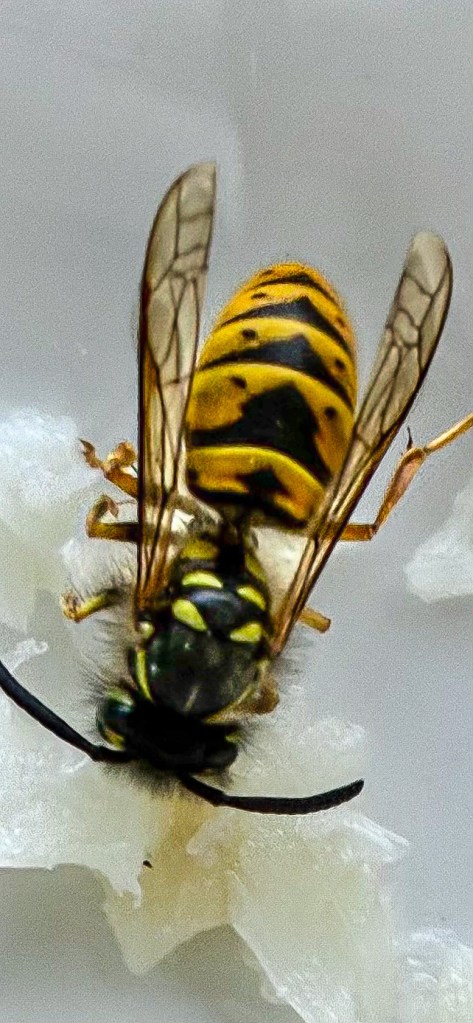
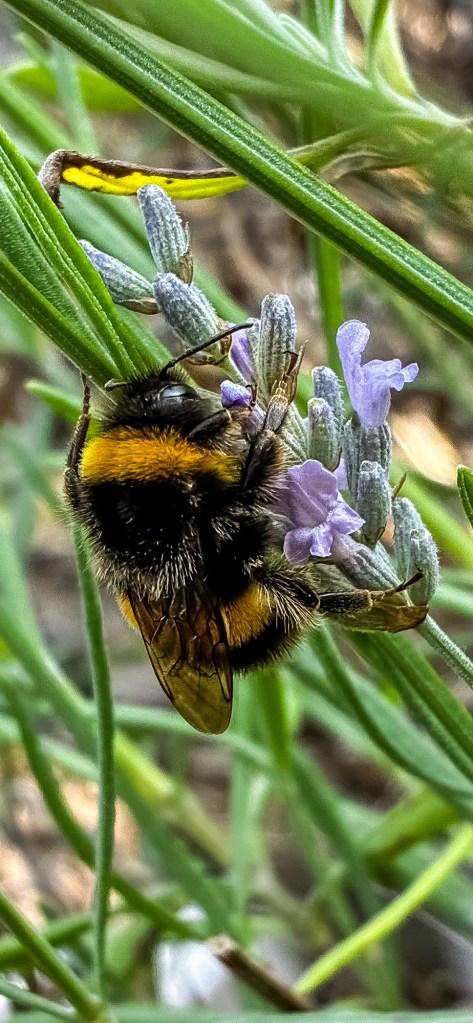
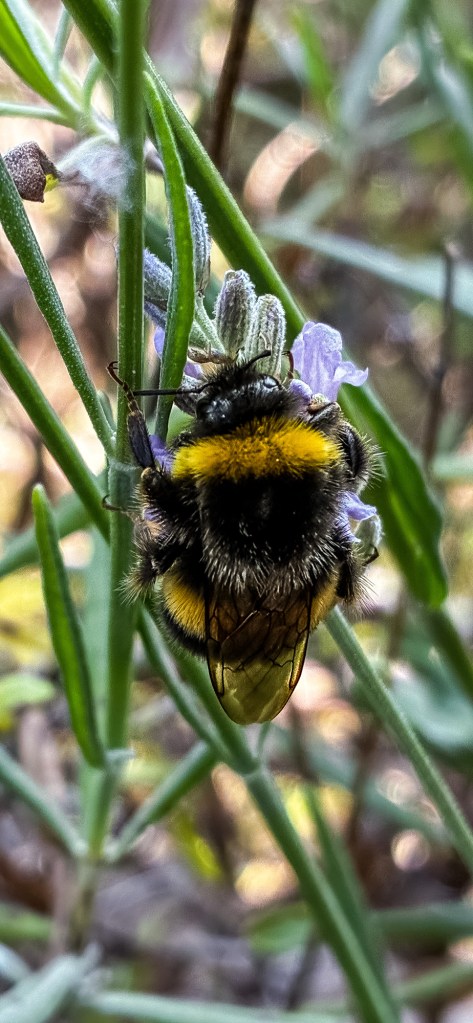
This week I’ve been practicing my macro photography, and it’s been mainly Bees. Firstly is a type of wasp (I think) called a YellowJacket.The Bumblebee pics are from the lavender in the garden, it’s a popular spot.
If you could erase one trend from history, what would it be?
If I could erase one trend from history, it wouldn’t be a fashion trend, or pineapple on pizza (although I know some of you are already sharpening your pitchforks).
It would be greed.
Not ambition.
Not success.
Not the desire to build something meaningful.
Greed.
Because there comes a point where wealth stops being about security and starts becoming about accumulation for accumulation’s sake.
We now live in a world where some individuals possess wealth measured in hundreds of billions of pounds, and we’re rapidly approaching the day someone will officially be recognised as a trillionaire. Meanwhile, millions of people struggle to afford food, heating or somewhere safe to live.
That should make us all pause for thought.
No single individual creates that amount of value alone.
Every successful business is built upon workers who turn up every day, customers who buy the products, publicly funded schools that educated the workforce, roads that transport goods, healthcare that keeps people healthy enough to work, and legal systems that protect commerce.
Success is rarely a solo achievement.
When one person accumulates more wealth than entire countries, I don’t see a triumph of capitalism.
I see a system that has drifted badly out of balance.
Because the truth is, wealth on that scale often relies upon underpaid labour, aggressive tax avoidance, monopolistic behaviour, and extracting far more from society than is ever returned.
That isn’t innovation.
It’s imbalance.
But greed isn’t confined to bank balances.
It quietly slips into the way we judge each other.
Some people decide another person’s worth by the clothes they wear.
Others by the car they drive.
The size of their house.
The colour of their skin.
Their accent.
Their country of origin.
Or the number on their payslip.
Surely we’ve learned by now that none of those things tell us anything meaningful about the character of the person standing in front of us.
The question shouldn’t be, “How much are they worth?”
It should be, “What do they contribute?”
Do they help others?
Do they make their community a little better?
Do they show kindness when nobody is watching?
Can they work alongside people with different backgrounds towards a common goal?
Those things matter.
Always have.
Always will.
History has shown us time and again that societies flourish when they value cooperation over division, compassion over prejudice, and contribution over consumption.
Perhaps if we spent a little less time admiring wealth, and a little more time admiring decency, we’d all be richer in the ways that actually matter.
Which outdated technology do you miss the most, and why?
The answer may surprise you, because it isn’t an old gadget or a forgotten piece of kit.
It’s letters.
Not because I’m against email. Far from it. Email is brilliant at what it does. It’s instant, searchable and gets the job done. When Adam from HR or Tom from Accounts needs last quarter’s numbers by 3pm, you don’t reach for a fountain pen and a sheet of A4.
But somewhere along the way, convenience quietly replaced something much more personal.
I joined the Army in the 1990s, before smartphones, social media and the internet became part of everyday life. Back then, one of the biggest highlights of the week was mail call.
It wasn’t just about hearing your name.
It was knowing that someone had sat down, found the time, and written to you. Every envelope was different. Different handwriting. Different paper. Sometimes there were photographs folded inside. Sometimes childish drawings. Sometimes a pressed flower, a train ticket or some other little keepsake that meant nothing to anyone else but everything to you.
And then there were the things technology still can’t replicate.
You can’t spray an email with her favourite perfume.
You can’t instantly recognise who’s written before you’ve even opened it because of the handwriting on the envelope.
And you certainly don’t get the entertainment of trying to decipher handwriting so spectacularly bad it needs its own translator.
A letter had character. It had imperfections. It had fingerprints, creases and coffee stains. It had travelled hundreds or even thousands of miles before it landed in your hands.
An email arrives exactly as it left.
A letter arrives with a story.
I still have letters tucked away in boxes that are over thirty years old. Every now and then I’ll stumble across one, unfold it and be transported straight back to that moment. I can’t say the same for emails buried somewhere in an inbox with 1,800 unread messages.
Technology has given us incredible ways to stay connected. We can video call someone on the other side of the world in seconds. We can send photos instantly. We can share our lives in real time.
That’s progress, and I wouldn’t want to lose it.
But I do think we’ve sacrificed a little of the human touch in the process.
Sometimes the slow way was the better way.
Not because it was more efficient, but because it reminded us that the person on the other end had invested something you can’t download or automate.
Time.
And perhaps that’s the bit of old technology I miss the most.
Do you think we’re shaped more by our experiences or by who we are?
This is one of those questions that sounds wonderfully simple.
Until you actually stop and think about it.
At first glance, most people tend to fall into one of two camps.
Some believe we’re born with a certain personality and that’s pretty much who we’ll always be.
Others argue we’re products of our environment—that life writes the story and we’re just the paper.
Personally?
I think the truth is somewhere in the middle.
But not in a neat little 50/50 split.
If I had to choose the stronger force, I’d probably say experiences do more of the sculpting.
Not because who we are doesn’t matter.
It matters enormously.
Our temperament, our natural way of seeing the world, our strengths, our vulnerabilities, the way our brains are wired… that’s the raw material we begin with. Some people are naturally cautious. Others adventurous. Some seem to feel every emotion at full volume while others process life more quietly.
Those foundations are real.
But foundations aren’t the finished house.
Life gets to work after that.
Every friendship. Every heartbreak. Every success. Every failure. Every act of kindness. Every betrayal.
Each one leaves a mark.
Sometimes those marks are barely noticeable.
Sometimes they’re deep enough to change the entire landscape.
I’ve often found myself looking back at moments I’d rather not have experienced at all, only to realise years later they quietly taught me something I couldn’t have learned any other way. Pain has an odd habit of becoming perspective, if we’re willing to let it. Failure often teaches resilience far better than success ever could. And the people who hurt us sometimes end up teaching us the sort of compassion we never imagined we’d possess. Those aren’t lessons we’re born with. They’re earned.
That doesn’t mean everyone responds to the same experiences in the same way.
Far from it.
Give two people the exact same childhood and they’ll often become completely different adults.
Why?
Because experience doesn’t happen in isolation.
It passes through the filter of who we already are.
The naturally optimistic person may see hardship as a challenge.
The naturally anxious person may experience the same hardship as proof the world isn’t safe.
Same event.
Different interpretation.
Different outcome.
That’s the fascinating part.
Life isn’t simply happening to us.
We’re constantly interacting with it.
It’s a conversation between our nature and our experiences, with each shaping the other over time.
Perhaps that’s why human beings are so wonderfully complicated.
We’re not born as blank slates.
Nor are we trapped by the person we happened to be at birth.
We’re works in progress.
Still learning.
Still adapting.
Still being quietly reshaped by the people we meet, the places we go, and the moments that catch us completely by surprise.
So yes, I think experiences probably do more of the sculpting.
But the sculpture still depends on the stone you started with.
What’s a piece of technology you’re convinced will exist in 20 years?
I know a lot of people immediately think of flying cars, and I have to admit, they’ve been promised for what feels like forever.
Every generation seems convinced they’re only a few years away. Yet somehow we’re still sitting in traffic, wondering why the person three cars ahead hasn’t noticed the light changed.
But I do think we’ll get there.
Not necessarily with everyone owning a flying car, though. If history has taught us anything, it’s that new technology usually starts off eye-wateringly expensive before slowly becoming normal.
What I can genuinely imagine is something a little different.
Driverless flying taxis.
Imagine standing outside your house, opening an app, and instead of a car pulling up at the kerb, a quiet electric aircraft lands on a designated pad nearby. You climb in, tell it where you’re going, and it simply… goes.
No steering wheel.
No traffic jams.
No arguing over who forgot to indicate.
Just computers doing what computers generally do best—following instructions.
The engineering doesn’t actually seem that far-fetched anymore. We already have autonomous vehicles being tested, drones capable of carrying significant loads, and electric aircraft making impressive progress. Put those technologies together, refine them over a couple of decades, and suddenly yesterday’s science fiction starts looking remarkably practical.
Of course, knowing my luck, the first time I stepped into one it would decide to update its software halfway through the journey.
“Please remain calm while FlightOS installs 7,483 important security updates…”
Maybe I’d wait for version two.
Still, I think this is one of those ideas that will eventually become so ordinary our grandchildren will struggle to understand why we spent hours crawling along motorways every Friday afternoon.
Just as we smile at the idea of people once believing the internet would never catch on, they’ll probably smile at us for thinking flying taxis sounded impossible.
The future has a funny habit of arriving one small step at a time.
Not because I have a wall full of certificates, or because I’m forever signing up for courses, but because life has a habit of reminding me just how much I still don’t know.
The older I get, the less interested I become in being right all the time.
I’d much rather understand.
That might sound like a small distinction, but I think it’s an important one.
Learning isn’t just about collecting facts. It’s about allowing new experiences to reshape old opinions. It’s about listening to people whose lives are completely different from your own and being willing to admit they might have something valuable to teach you.
Some of the greatest lessons I’ve learned haven’t come from classrooms at all.
They’ve come from raising children.
From loving someone.
From making spectacular mistakes.
From living with autism long before I understood I was autistic.
From photography, where standing still and really looking at the world often reveals beauty everyone else walked straight past.
And, of course, from books.
Books have introduced me to worlds I’ll never visit, people I’ll never meet, and ideas that have quietly changed the way I see life.
One of those ideas comes from the Buddha.
Whether you see Buddhism as a religion or simply a philosophy, there’s something deeply refreshing about the idea that we’re all works in progress.
The Buddha didn’t really teach that life should be comfortable.
He taught that it could be understood.
The Four Noble Truths ask us to look honestly at suffering instead of pretending it isn’t there. The Eightfold Path isn’t a quick fix or a self-help slogan. It’s a lifelong practice of becoming a little wiser, a little kinder and a little more compassionate than we were yesterday.
I like that.
Not because I expect to become enlightened.
Let’s be honest—I still lose my patience when technology decides today is the perfect day to update itself.
But because it reminds me that growth isn’t a destination.
It’s a direction.
Too often we think learning stops when school finishes, or when we retire, or when we reach a certain age.
I think that’s when the real education begins.
Every conversation teaches us something.
Every mistake offers a lesson—assuming our pride doesn’t get in the way.
Every challenge asks us whether we’re prepared to adapt or whether we’d rather stay comfortably wrong.
For me, lifelong learning isn’t about becoming the smartest person in the room.
It’s about becoming a slightly better version of the person who walked into it.
If I can go to bed tonight knowing something I didn’t know this morning…
If I can understand another person’s perspective just a little more…
If I can show a little more compassion than I managed yesterday…
What’s one habit that has improved your life the most?
f I had to choose just one habit, it would be meditation.
Not because it gives me all the answers, but because it helps me stop fighting battles that only exist in my own mind.
For a long time, I held onto anger. I replayed conversations, revisited old hurts, and carried resentment far longer than I probably should have. I thought holding on somehow made me stronger or somehow proved I was right.
It didn’t.
It only hurt me.
The people or situations I was angry about often carried on with their lives while I carried the weight. Looking back, it seems like such a waste of energy.
Meditation changed that.
It didn’t erase the past. It simply taught me to observe my thoughts without becoming trapped by them. It reminded me that I always have a choice: hold on or let go.
Most of the time, letting go is the better option.
Not because what happened doesn’t matter, but because my peace matters more.
These days, I still get frustrated. I’m only human. But I no longer give anger a permanent home. I acknowledge it, learn what I can from it, and move forward .
That small daily practice has made me calmer, more patient, and far more present.
Funny really. I started meditating to quiet my mind.
What I discovered was that the greatest benefit wasn’t learning how to be still.
It was learning what was never worth carrying in the first place.
Stay Safe
Bc
Ps here’s a scribble I wrote on this subject some time ago
What’s a chapter of your life you’d title “The Hard Years” — and what got you through it?
If you’ve read my books or been following this blog for a while, you’ll probably know the answer before you’ve finished the question.
Roughly twenty years ago.
That was the chapter.
It was the point where it honestly felt like life had looked at me and thought, “Go on then… let’s see how much this bloke can actually take.”
I was on the verge of homelessness.
I was fighting to have a relationship with my daughters.
My PTSD was running riot.
I was autistic but had absolutely no idea at the time.
And my mental health?
Well… “shot to shit” is probably the most accurate medical diagnosis I can give you.
Let’s unpack that.
After a relationship ended, I found myself with nowhere to live. My family couldn’t help, so I ended up sleeping on the sofa of an old wrestling mate. It wasn’t glamorous, but it beat sleeping rough again.
Eventually she moved in with her boyfriend and we came up with what seemed, at the time, like a sensible solution.
I’d stay in her little council house and carry on paying the rent.
Yes.
I know.
Subletting.
Not exactly legal.
But when your choices are breaking the rules or sleeping rough, morality suddenly becomes a luxury.
While all that was going on, my daughters’ mum had started making contact as difficult as humanly possible.
I’d turn up to collect the girls.
“Oh… we’ve gone out.”
“They’re not here.”
“They don’t want to come.”
The excuses changed.
The result didn’t.
Letters from my solicitor about parental responsibility went unanswered.
Phone calls rarely got through.
And when they did, the girls were apparently never available.
It was only last year that I found out some of the things they’d been told about me growing up.
One of them was that I’d wanted my youngest aborted before she was born.
I hadn’t.
But lies have a habit of hanging around long after the people telling them have moved on.
Looking back now, I understand why I was falling apart.
Back then I just thought I was broken.
Everything piled on top of everything else.
The housing.
The court stuff.
Missing my girls.
The PTSD.
Trying to make sense of a brain that worked differently without knowing why.
So I did what a lot of blokes do when they’re drowning.
I reached for anything that promised five minutes of peace.
Drink.
Drugs.
Self-harm.
None of it fixed anything.
It just delayed having to feel it.
Then came the moment that genuinely broke me.
The council discovered I was living in the house.
I was told that if I cleared about £400 of rent arrears I could take over the tenancy.
I worked every bit of overtime I could.
Paid every penny.
Walked into the meeting convinced I’d finally caught a break.
Instead, I was told I had four weeks to move out.
When I reminded them about what I’d been promised, I was told I’d have to bid on the property along with everyone else.
I’d basically paid someone else’s rent arrears for nothing.
That one hurt.
For the next month I bid on every property I could.
Nothing.
That’s when I hit rock bottom.
I tried (for the first time) to end my life.
I woke up in hospital the following day to two police officers asking why I’d done it and telling me how selfish I’d been for upsetting everyone.
Different times.
Thankfully we’ve moved on a bit since then.
Recovery wasn’t some magical Disney montage.
It took years.
Hospital admissions.
Medication.
Counselling.
Learning how to exist without constantly wanting to disappear.
Then, during one of my final stays in hospital, a member of staff suggested I start writing down how I felt.
I nearly laughed.
Writing a diary?
Really?
I’d grown up believing men dealt with problems by getting on with them.
You certainly didn’t write about your feelings.
Still…
I’d tried almost everything else.
What was one more roll of the dice?
Those first pages weren’t poetry.
They were just chaos.
Anger.
Fear.
Grief.
Questions I didn’t know how to answer.
Slowly, without me really noticing, those pages started changing.
Sentences became verses.
Verses became poems.
Poems became something that made sense of everything that didn’t.
People often ask me what saved my life.
It wasn’t poetry.
Not at first.
Poetry came later.
What saved me was finally giving myself permission to be honest.
The poetry simply gave that honesty somewhere to live.
Without those notebooks there probably wouldn’t have been books.
There wouldn’t have been performances.
There wouldn’t have been conversations with complete strangers who’ve quietly said, “I thought I was the only one.”
There probably wouldn’t be this blog.
So what got me through The Hard Years?
My daughters.
Even when I couldn’t see them, they gave me something to keep fighting for.
Pure bloody-minded stubbornness.
I’ve never liked being told I can’t do something.
And somewhere deep down, underneath everything else, there was still a tiny voice saying,
“Don’t let this be how your story ends.”
Turns out that little voice was right.
Life isn’t perfect now.
It never will be.
But I’ve learned that the hardest chapters aren’t always the end of the book.
Sometimes they’re just the part that explains why the rest of the story matters.